

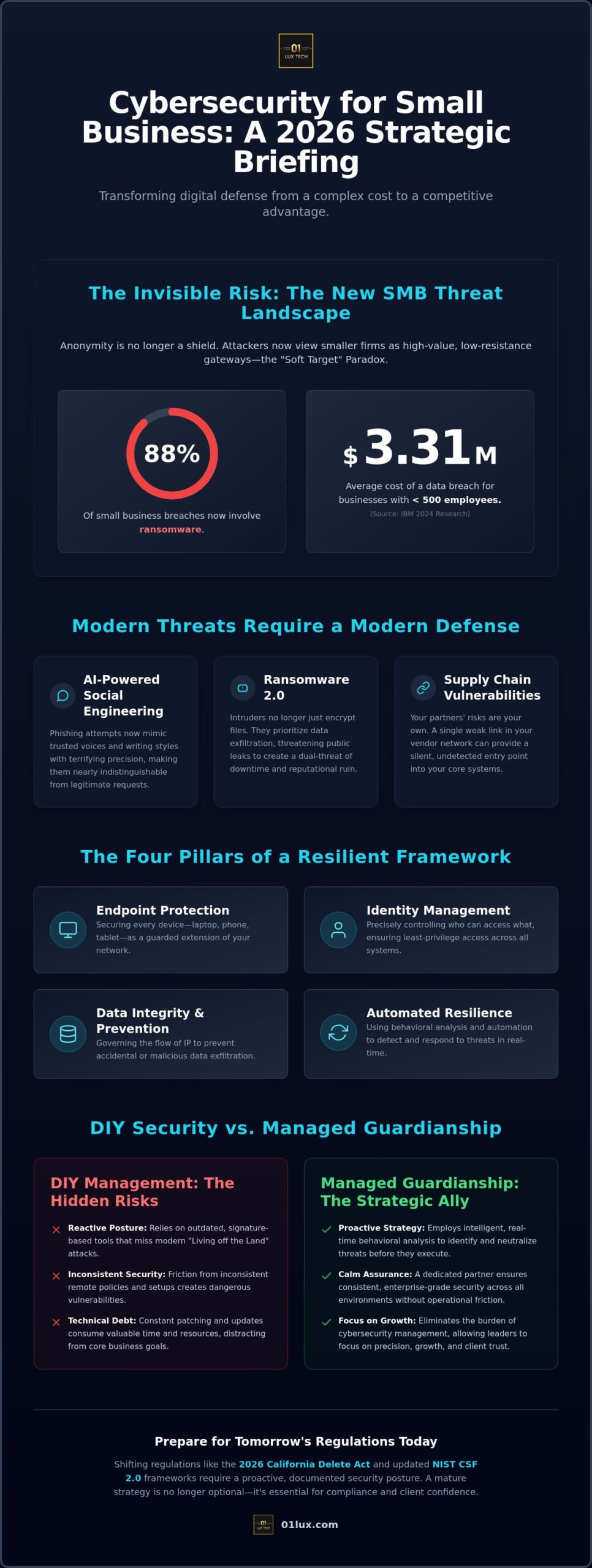
What if your digital defense wasn’t a draining expense, but the very foundation of your firm’s elite reputation? For many leaders, the reality is far more stressful. With 88% of small business breaches now involving ransomware, the fear of a sudden, 3.31 million dollar disruption is a heavy burden to carry. It’s easy to feel overwhelmed by shifting regulations like the 2026 California Delete Act or the friction of inconsistent remote security. You deserve a strategy that works silently in the background.
We understand that you prioritize precision and growth over technical jargon. This guide will show you how to transform cybersecurity for small business from a complex chore into a seamless strategic advantage. You’ll discover how to build a proactive posture that safeguards your data integrity while commanding absolute client trust. We’ll explore the essential 2026 frameworks, from NIST CSF 2.0 updates to automated resilience, ensuring your operations remain uninterrupted and your vision stays clear.
Key Takeaways
- Shift your perspective on risk to recognize why limited resources often attract sophisticated digital threats.
- Identify the core pillars of a modern framework, from precise identity management to robust endpoint protection.
- Discover how a proactive roadmap for cybersecurity for small business eliminates the friction of technical debt.
- Compare the hidden vulnerabilities of DIY management against the calm assurance of a dedicated strategic ally.
- Learn the exact steps to conduct a vulnerability audit and establish a sophisticated data breach prevention policy.
The Invisible Risk: Why Small Businesses are the New Primary Targets
Anonymity is no longer a shield. For years, many leaders believed their size offered a natural protection against digital threats. This was a misconception. In the current landscape, attackers view smaller firms as high-value, low-resistance gateways. This is the “Soft Target” Paradox. While a global corporation may have a hardened perimeter, a growing firm often lacks the same level of architectural defense. Attackers don’t seek the most difficult challenge; they seek the most efficient path to a payout. They bank on your limited resources and your focus on growth over guardianship.
The financial impact of this misplaced confidence is stark. According to IBM 2024 research, the average cost of a data breach for businesses with fewer than 500 employees is $3.31 million. However, the true cost extends far beyond the immediate balance sheet. Reputational erosion is a silent, permanent tax on your brand’s future. For an elite service provider, trust is the primary currency. Once data integrity is compromised, that trust is difficult to restore. A breach doesn’t just halt operations; it stains the craftsmanship of your reputation.
The Los Angeles business landscape presents unique digital signatures that attract sophisticated theft. Our city is a high-density environment of media, technology, and professional services. Each transaction carries a layer of prestige that attackers find irresistible. Local firms are often targeted not just for their own data, but as a gateway to their high-profile clients and partners. This makes a comprehensive approach to cybersecurity for small business an essential prerequisite for any modern partnership. You must shift your mindset from “if” an attack will happen to “when” it will be attempted. Constant vigilance is the hallmark of a mature executive strategy.
The Evolution of Modern Digital Threats
Modern attackers have refined their craft into a sophisticated digital con. Social engineering now uses AI to mimic trusted voices and precise writing styles, making phishing attempts nearly indistinguishable from legitimate requests. Ransomware 2.0 has also evolved. Intruders no longer just encrypt your files; they prioritize data exfiltration. They threaten to leak sensitive client information unless a ransom is paid, creating a dual-threat of downtime and public exposure. Additionally, supply chain vulnerabilities mean your partners’ risks are now your own. A single weak link in your vendor network can provide a silent entry point into your core systems.
Why Traditional Antivirus is No Longer Sufficient
Legacy software relies on signature-based detection, which only recognizes threats that have been previously identified and cataloged. This leaves your firm vulnerable to “Living off the Land” (LotL) attacks. In these scenarios, intruders use legitimate system tools to carry out malicious acts, bypassing traditional filters entirely. In 2026, effective Cybersecurity principles require a shift toward behavioral analysis. You need an intelligent defense layer that identifies anomalies in real time. This proactive stance is the cornerstone of robust cybersecurity for small business. It moves your organization from a state of reactive repair to one of disciplined, proactive guardianship.
The Four Pillars of a Sophisticated Cybersecurity Framework
A sophisticated defense is not a single wall. It’s a cohesive architecture of four essential pillars that transform your digital posture from reactive to resilient. While basic FCC cybersecurity tips provide a foundational starting point, an executive-level strategy requires a more refined approach to cybersecurity for small business. Every component must be meticulously designed to support growth while ensuring absolute data integrity.
Endpoint protection is the first pillar. In a hybrid work world, every laptop in a home office and every smartphone in a transit hub is a potential entry point. We secure the device to protect the network. Modern defense ensures these endpoints are not just connected, but guarded with the same rigor as your primary server. This creates a seamless, encrypted perimeter that moves with your team, allowing for uninterrupted progress regardless of location.
Data integrity forms the third pillar, moving far beyond simple nightly backups. It requires active data loss prevention solutions that monitor how your intellectual property moves. We don’t just store data; we govern its flow. This foresight prevents the accidental or malicious exfiltration of sensitive client details. Finally, network resilience ensures your infrastructure can withstand pressure. It’s about creating an environment where security is felt through its silence, operating perfectly behind the scenes.
Identity as the New Perimeter
Traditional boundaries have dissolved. Identity is now the primary gateway to your firm’s most valuable assets. We embrace a Zero Trust Architecture: never trust, always verify. Multi-Factor Authentication (MFA) is no longer an option; it’s a non-negotiable standard for every user. For high-level executives, managing privileged access is even more critical. We ensure that the right access is granted at the precise moment, and only for as long as necessary. This discipline limits exposure and maintains a state of calm, proactive assurance.
Advanced Threat Detection and AI Monitoring
Precision requires automation. AI-driven systems now identify subtle anomalies in network behavior before they can escalate into full breaches. This 24/7 vigilant monitoring is the hallmark of a premium security posture. Managed Detection and Response acts as a proactive guardian service, providing human expertise backed by machine intelligence to ensure perfection in your digital landscape. Partnering with a sophisticated strategic ally ensures these pillars remain upright as your business scales, turning cybersecurity for small business into a silent catalyst for long-term success.
DIY Security vs. Managed Guardianship: A Strategic Comparison
Software is a tool. Strategy is a shield. Many leaders fall into the trap of believing that a suite of high-end licenses constitutes a complete defense. This is a dangerous simplification. Effective cybersecurity for small business requires more than just installation; it demands continuous, expert oversight. A DIY approach often leaves gaps that only become visible during a crisis. By then, the damage to your operational flow is already done. You don’t just need a license. You need a sentinel.
The financial contrast between these two paths is significant. A managed partnership offers a predictable investment, allowing you to budget with precision and confidence. In contrast, relying on internal generalists or basic software often leads to the catastrophic expense of emergency recovery. These hidden costs include massive downtime, lost productivity, and the frantic redirection of resources. Aligning with CISA’s guidance for businesses, a strategic partner moves you away from reactive repair toward a state of calm, proactive assurance.
The Opportunity Cost of Internal IT Management
Time is your most finite asset. When your internal team spends hours on manual updates, patches, and alert monitoring, they aren’t focusing on growth. This leads to “Security Fatigue,” where critical warnings are lost in a sea of routine noise. Small teams often lack the specialized depth to recognize sophisticated, low-signal threats. Professional management eliminates this distraction. It ensures your digital environment remains optimized and secure, allowing your staff to remain disciplined in their primary roles. We handle the complexity so you can maintain your momentum.
The LUX Standard of Proactive Protection
Boutique businesses require craftsmanship, not a one-size-fits-all solution. Generic security software fails to account for the unique digital signatures of an elite firm. Our approach focuses on customization, ensuring your defense is as unique as your brand. We move your organization into a state of perpetual readiness, where threats are neutralized before they reach your perimeter. By offloading technical anxiety to elite specialists, you transform your technology into a seamless catalyst for success. Discover how our managed IT services Los Angeles provide the meticulous guardianship your vision deserves. This is the difference between merely surviving the digital age and truly commanding it. High-level cybersecurity for small business isn’t a burden; it’s your most quiet and powerful competitive advantage.
Building Your 2026 Defense: A Strategic Implementation Roadmap
Precision requires a plan. While the risks are invisible, your response must be deliberate and highly organized. Transitioning to a sophisticated posture isn’t about rapid, reactive changes. It’s about following a rhythmic journey from vulnerability to resilience. This roadmap ensures that your cybersecurity for small business strategy remains a silent catalyst for progress rather than a source of friction. We move logically from high-level concepts to practical, elite protection.
Phase One: Assessment and Hardening
Every elite defense begins with a clear view of the current state. We start with a comprehensive digital audit and vulnerability assessment. This initial audit serves as a diagnostic for business health, revealing hidden gaps before they can be exploited. We prioritize identifying your “Crown Jewels,” the critical data sets and intellectual properties that define your brand’s prestige. Once identified, we focus on closing the most obvious windows. This involves meticulous patching and legacy system updates to eliminate low-level entry points. Implementing a business data breach prevention policy at this stage codifies your commitment to data integrity. It sets a high-end standard for how information is handled, stored, and protected across your entire infrastructure.
Phase Two: Culture and Continuity
Security is a shared discipline. Even the most advanced technical barriers can be undermined by a single human error. This is why we focus on establishing a culture of vigilance. We train your staff to recognize the “Craftsmanship of a Phish,” ensuring they can spot the subtle cues of high-end social engineering. Beyond training, we secure the remote workforce through encrypted cloud integration. This creates a seamless environment where security follows the user, rather than restricting them. We also prioritize testing your resilience. Incident response planning ensures that if a disruption occurs, your team knows exactly how to maintain operational flow. Ensuring your ransomware prevention for business Los Angeles is ironclad protects your firm from the most devastating modern threats. It transforms cybersecurity for small business into a proactive, “set-and-forget” guardian for your vision.
The final step is continuous optimization. A static defense is a failing defense. Partnering with an elite strategic ally ensures your systems are always refined, monitored, and ready for the next evolution of digital threats. If you’re ready to secure your firm’s future with meticulous precision, contact 01 LUX Tech today for a comprehensive digital audit and strategic consultation.
Proactive Guardianship: Partnering with 01 LUX Tech
Excellence is the standard in Los Angeles. In a landscape defined by prestige and rapid innovation, your digital defense must be impeccable. 01 LUX Tech provides this level of meticulous guardianship. We don’t just offer managed IT; we provide a white-glove experience designed for executives who value precision. By choosing our team, you transform cybersecurity for small business from a technical necessity into a strategic hallmark of your brand’s integrity. Our approach is proactive. It is disciplined. It is built to ensure your focus remains entirely on your vision.
A sophisticated defense should be felt through its silence. We move beyond simple protection to create a seamless environment where technology acts as a catalyst for growth. When your infrastructure is resilient, your team moves faster. When your data is secure, your clients trust you more deeply. This invisible defense allows you to operate with the calm assurance that your digital assets are being monitored by elite specialists. We handle the complexity of the 2026 threat landscape so you can command your market with absolute confidence.
A Partnership Built on Precision and Trust
Local expertise is our foundation. We understand the unique digital signatures and high-value risks inherent to the Beverly Hills and Santa Monica markets. You don’t just get a help desk; you gain direct access to strategic advisors who prioritize your business continuity. Our relationship is built on the traditional values of reliability and trust, enhanced by forward-thinking innovation. We act as your meticulous sentinel, ensuring that every layer of your network reflects the craftsmanship and prestige of your own firm. Your digital prestige is our primary mission.
Next Steps to Secure Your Legacy
Securing your firm’s future requires a deliberate first step. We invite you to initiate a private security consultation to evaluate your current posture and identify opportunities for hardening. Our transition process is designed to be seamless, professional, and thorough. We integrate with your existing workflow without causing disruption, providing a clear roadmap from your current state to one of perpetual readiness. Do not leave your reputation to chance. It is time to align with a partner who values your legacy as much as you do. Elevate your defense with 01 LUX Tech and experience the peace of mind that comes with elite cybersecurity for small business.
Command Your Digital Future with Precision
Modern defense demands more than reactive patches; it requires a vision of total data integrity. We’ve explored how a sophisticated framework and a proactive roadmap turn technical vulnerability into a silent competitive advantage. By shifting from the high-risk friction of DIY management to an elite guardianship model, you ensure your operations remain uninterrupted. High-end cybersecurity for small business is no longer a burden to manage. It is the foundation upon which your digital prestige is built.
01 LUX Tech brings meticulous craftsmanship to high-stakes Los Angeles commercial environments. We combine proactive, AI-driven monitoring with customized frameworks designed specifically for elite business growth. Your legacy deserves a defense that is as ambitious as your vision. It’s time to replace technical anxiety with the quiet confidence of a well-guarded perimeter.
Secure Your Business Future with a Private Consultation
Your journey toward a resilient, seamless future begins with a single, disciplined choice. We look forward to guarding your progress.
Frequently Asked Questions
Is cybersecurity for small business really necessary in 2026?
Yes, because attackers now prioritize smaller firms as efficient entry points to broader supply chains and high-value data. With 61% of small businesses experiencing a cyber breach in the past year according to PreVeil 2025, the risk is a mathematical reality. Cybersecurity for small business has evolved from a technical utility into a prerequisite for brand prestige and operational continuity.
What is the most common cyber attack on small businesses today?
Phishing and social engineering remain the most frequent vectors for digital intrusion. These attacks use AI to craft highly convincing messages that bypass traditional filters and exploit human error. Once a user clicks, attackers often deploy ransomware, which Verizon’s 2025 DBIR notes is involved in 88% of small business breaches. This makes elite employee training a cornerstone of a sophisticated defense.
How much should a small business invest in cybersecurity?
Investment should be viewed as a percentage of operational risk rather than a flat fee. While 47% of businesses with fewer than 50 employees currently have no cybersecurity budget according to CrowdStrike 2025, elite firms prioritize a predictable, managed investment. This foresight prevents the catastrophic expense of emergency recovery and the reputational erosion that follows a major data loss incident.
Can my business be secure if my employees work remotely?
Remote work is secure when you implement a Zero Trust Architecture and encrypted cloud integration. Security must follow the identity of the user rather than being tethered to a physical office. This creates a seamless perimeter that protects your intellectual property across any transit hub or home office. We ensure that access is verified at every step, maintaining a state of calm, proactive assurance.
What happens if my business is hit by ransomware?
A ransomware incident triggers an immediate crisis of downtime and potential data exfiltration. Beyond the encryption of files, modern attackers prioritize stealing sensitive client details to use as leverage. A proactive incident response plan is essential to maintain operational flow. Without one, 40% of small businesses state that an attack costing $100,000 or less could put them out of business according to VikingCloud 2025.
How often should we conduct a cybersecurity audit?
You should conduct a comprehensive digital audit at least once a year, or whenever significant changes occur in your infrastructure. Regular assessments act as a diagnostic for business health. They ensure your defense remains aligned with evolving standards like the NIST CSF 2.0 revision. This rhythmic evaluation identifies invisible vulnerabilities before they can be exploited by sophisticated attackers.
Is cloud storage safer than on-premise servers for my data?
Cloud storage is generally superior because it offers professional-grade redundancy and automated resilience. Sophisticated cloud environments provide a level of monitoring and physical security that is difficult for a boutique firm to replicate on-premise. It turns your infrastructure into a seamless catalyst for growth, ensuring your data remains accessible and well-guarded behind the scenes.
How do I know if my current IT setup is actually secure?
A setup is only secure if it includes 24/7 vigilant monitoring and real-time behavioral analysis. If your current provider relies solely on reactive repair or basic antivirus, you likely have significant gaps in your cybersecurity for small business strategy. A private security consultation provides the clarity needed to transform your posture from a state of frustration into one of disciplined guardianship.