

Did you know the average cost of a data breach in the United States has climbed to a staggering $10.22 million in 2026? This figure represents more than just a financial hit; it’s a direct threat to your hard-earned reputation. You’ve likely felt the mounting pressure of securing a hybrid workforce while AI-driven attacks become more sophisticated by the hour. It’s a complex challenge that requires more than a reactive mindset. Effective business data breach prevention is no longer a simple technical requirement. It’s a strategic necessity. It’s a commitment to excellence. It’s the foundation of your future growth.
This article provides an elite framework for securing your enterprise through meticulous planning and proactive defense. We’ll guide you through building a seamless, invisible security layer that protects your assets without creating technical friction. You’ll discover how to navigate the latest CIRCIA reporting mandates and SEC cybersecurity rules with absolute precision. We’ll move from the anxiety of potential vulnerability to a state of quiet, disciplined resilience. Let’s transform your security posture into a catalyst for success and a guardian of your professional legacy.
Key Takeaways
- Understand the evolution of digital threats from simple phishing to hyper-personalized AI deepfakes.
- Master the LUX Framework to implement a sophisticated strategy for business data breach prevention through Zero Trust principles.
- Transform your workforce into a human firewall that complements advanced technical safeguards like EDR and XDR.
- Utilize a meticulous 2026 checklist to conduct technical audits and enforce non-negotiable security standards across your enterprise.
- Discover how elite managed IT partnerships provide the proactive assurance needed to scale your business without increasing vulnerability.
The 2026 Threat Landscape: Beyond Simple Phishing
The era of the obvious, misspelled phishing email has ended. In 2026, threats are surgical, quiet, and profoundly personal. For any modern leader, business data breach prevention is no longer about building a taller wall. It’s about developing a more intelligent, responsive immune system. Passive security has become a significant liability. In an environment where a data breach in the United States now costs an average of $10.22 million, the price of silence is simply too high. You cannot afford to wait for a signal. You must anticipate the silence before it’s broken.
Vigilance is the new standard of excellence. We’ve moved beyond the cycle of reactive patches. Modern defense relies on proactive immunity. In this landscape, automation serves as both the shield and the sword. While attackers use AI to identify vulnerabilities at lightning speed, elite enterprises use it to close those gaps even faster. It’s a race of precision. It’s a commitment to being better prepared than the adversary. This proactive stance is what separates a resilient business from one that’s merely lucky.
AI-Enhanced Social Engineering
AI-driven social engineering represents the primary threat vector for enterprises in 2026. Attackers now leverage generative AI to clone executive voices and personas with unsettling accuracy. A voice memo that sounds like your CFO or a video call that looks like a trusted partner is no longer beyond the reach of criminals. This evolution of vishing and smishing bypasses traditional filters by exploiting human trust. Neutralizing these threats requires a meticulous, multi-layered verification process. It’s about moving from “trust but verify” to a state of absolute, continuous authentication. Precision is your best defense against business data breach prevention challenges involving human deception.
The Hybrid Work Vulnerability
The corporate perimeter has effectively vanished. Your network now extends from high-rise headquarters to a home office in Santa Monica or a private study in Beverly Hills. This “office of one” model offers flexibility, but it often invites shadow IT into the fold. When employees use unauthorized cloud tools for convenience, they create invisible entry points for intruders. Securing this decentralized environment requires a sophisticated approach. You need to provide seamless connectivity that doesn’t compromise the core network. It’s a balance of high-level performance and uncompromising safety. Each remote endpoint must be treated with the same rigor as the server room itself.
The LUX Framework: Structural Prevention Foundations
True security isn’t a reaction. It’s a foundation. The LUX Framework treats business data breach prevention as an architectural discipline rather than a series of software patches. We start with absolute visibility. If you cannot see an asset, you cannot defend it. Many organizations operate in a fog of unknown devices and forgotten cloud instances. This ambiguity is where threats reside. By establishing structural foundations, we replace uncertainty with precision. It’s a journey from chaos to clarity. It’s the hallmark of a well-guarded enterprise.
Comprehensive Asset Inventory
Mapping your digital estate is the first step toward true guardianship. This involves cataloging every endpoint across your network. We look at mobile devices in the field. We audit cloud-based SaaS platforms. We identify your “crown jewel” data. This is the intellectual property that defines your competitive advantage. Proper lifecycle management for legacy hardware is equally vital. Old systems are often the quietest entry points for modern intruders. As highlighted in the FTC’s A Guide for Business, knowing exactly what data you hold is the prerequisite for keeping it safe.
Encryption at rest and in transit serves as your final line of defense. It renders stolen data useless to those without the key. However, encryption alone isn’t enough. We move from periodic audits to continuous monitoring. With the average breach lifecycle reaching 241 days in 2026, real-time visibility is the only way to shorten the window of exposure. It’s the difference between a smoke detector and a fire department already on the scene. Vigilance must be constant. Protection must be absolute.
Zero Trust as a Business Catalyst
Zero Trust isn’t just a security model. It’s a business catalyst. By centering security on identity, we enable faster and more secure remote access. Employees work with confidence. Partners collaborate without friction. Trust nothing. Verify everything. Micro-segmentation ensures that even if one area is compromised, the threat cannot move laterally. It contains the risk. Integrating data loss prevention solutions into this model creates a redundant, high-performance safety net. This approach turns security from a bottleneck into a competitive edge. Strategic planning ensures that your growth remains uninterrupted. If you’re ready to move beyond basic checklists, exploring sophisticated infrastructure solutions can provide the clarity your enterprise deserves.
Technical Safeguards vs. Human Vigilance
The most sophisticated technical architecture is only as strong as the person operating it. Elite business data breach prevention requires a harmony between machine precision and human intuition. We’ve moved beyond the era of simple antivirus software. Today, we deploy Endpoint Detection and Response (EDR) and Extended Detection and Response (XDR) to maintain a proactive stance. These tools don’t just wait for a known virus signature. They hunt for anomalies. They analyze behavior. They provide a deeper level of foresight that traditional methods lack. Technology provides the data; humans provide the context.
This synergy is essential because the human element remains a primary attack vector. Research on Enhancing Data Breach Prevention Measures demonstrates that technical controls must align perfectly with corporate policies and human behavior to be truly effective. With 48% of companies reporting an increase in insider attacks in 2026, your team is either your greatest vulnerability or your most resilient shield. We choose to build the latter. We transform your staff into a “Human Firewall” through continuous engagement and clear, authoritative guidance. It’s a commitment to being prepared. It’s a culture of quiet competence.
Effective security should be a seamless experience for the user. If a safeguard creates too much friction, employees will find ways to bypass it. This creates shadow IT risks. We aim for an invisible security layer. It protects without obstructing. It secures without slowing down. By balancing high-level security with a frictionless user experience, you ensure that business data breach prevention becomes a natural part of the daily workflow rather than a technical hurdle.
Advanced Data Loss Prevention (DLP)
- Automated Discovery: Identify sensitive data leaking through email or cloud sharing before it leaves the perimeter.
- Policy Enforcement: Implement strict, automated rules that prevent unauthorized data exfiltration in real time.
- Precision Protection: Automated Data Loss Prevention serves as the definitive cornerstone for safeguarding a firm’s intellectual property from unauthorized exfiltration.
Cultivating an Elite Security Culture
Compliance training shouldn’t be a tedious box-ticking exercise. It should be a high-stakes, engaging experience. We utilize sophisticated simulations that mirror real-world threats to sharpen your team’s instincts. This “white-glove” approach to internal IT support makes reporting a suspicious event feel like a contribution to the company’s success rather than a burden. When employees feel like proactive guardians, the entire organization becomes more resilient. It’s about meticulous attention to detail. It’s about long-term planning. It’s about a shared vision of safety.
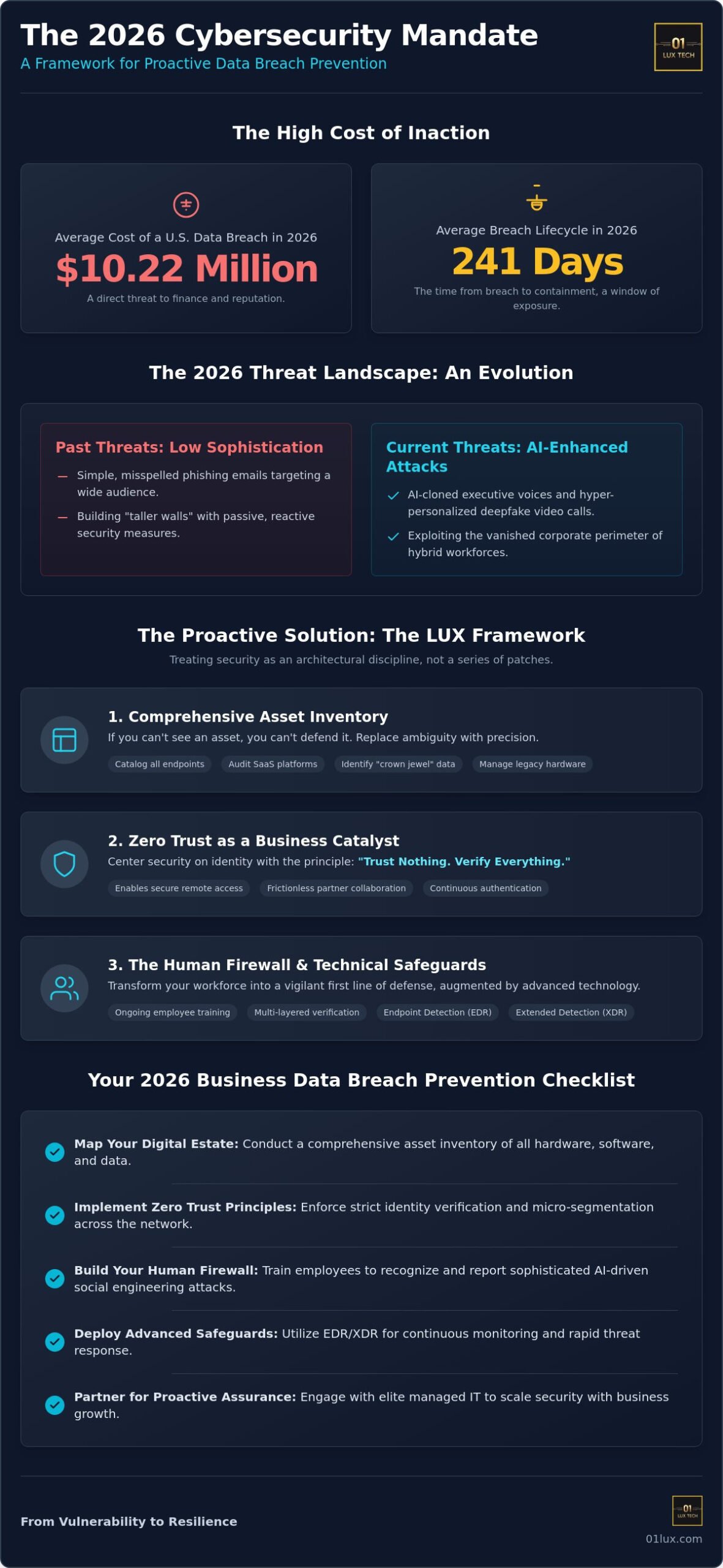
The Business Data Breach Prevention Checklist for 2026
Annual security reviews are a relic of a slower era. In 2026, the velocity of threats demands a more agile approach. A static checklist is insufficient. You need a living strategy. This framework identifies immediate vulnerabilities and builds long-term resilience. Business data breach prevention is an ongoing commitment to excellence. It requires a disciplined focus on the details that others often overlook. By following this meticulous path, you move from a state of potential risk to a position of quiet strength. It’s about moving beyond compliance to achieve true immunity.
- Immediate Technical Audits: Identify low-hanging fruit and critical gaps in your current architecture through deep-dive logic assessments.
- Universal Multi-Factor Authentication: Enforce phishing-resistant MFA across the entire organization. There are no exceptions for executives or high-level partners.
- Automated Patch Management: Eliminate the window of vulnerability by ensuring all systems are updated in real time without manual intervention.
- Regular Penetration Testing: Think like an attacker. Find the cracks in your perimeter before an adversary exploits them.
- Incident Response Tabletops: Test the “unthinkable” through rigorous, realistic simulations that challenge your leadership’s decision-making under pressure.
Phase 1: Immediate Hardening
Start with the essentials. Enforce phishing-resistant MFA for every corporate account. This is a non-negotiable standard that mitigates the risk of credential theft. Next, audit your third-party vendor access. Ensure their security posture aligns with your LUX standards. Many breaches originate in the supply chain. You must secure the network infrastructure for every local office branch, ensuring no weak points exist in your decentralized perimeter. It’s about precision. It’s about closing every door before an intruder finds it open. This phase is about removing the easy targets and forcing attackers to look elsewhere.
Phase 2: Strategic Resilience
True security requires constant vigilance. Establish a 24/7 Security Operations Center (SOC) presence to monitor for anomalies in real time. This provides the “eyes-on-glass” capability needed to catch sophisticated threats that automated tools might miss. Develop a clear communication plan for stakeholders and clients in Beverly Hills and beyond. Transparency builds trust. Finally, integrate these security layers into a comprehensive managed IT services Los Angeles framework. This ensures that protection isn’t an afterthought. It becomes part of your business’s DNA. If you want to elevate your defense, consider how our elite cybersecurity solutions can provide the meticulous guardianship your brand requires.
Elevating Security with Managed IT Partnerships
Reactive IT is a significant liability in 2026. Waiting for a system to fail before addressing it is an invitation for disaster. This “break-fix” mentality leaves your digital doors unlocked while your team focuses on growth. A proactive partnership is the only way to ensure business data breach prevention remains a constant reality rather than a desperate hope. It’s about foresight. It’s about craftsmanship. We don’t just repair systems; we refine and protect them before a vulnerability can be exploited. This disciplined approach transforms your technology from a source of anxiety into a foundation of strength.
Scalability shouldn’t come at the cost of your safety. As your business expands, your digital footprint naturally grows. Managed IT services ensure that your security layer scales in tandem with your professional ambitions. This is the LUX standard. It’s elite, personalized guidance tailored for the specific needs of high-performance firms. We treat your infrastructure with meticulous care, positioning your robust security posture as a powerful differentiator for your brand. In a market where trust is the ultimate currency, being known for uncompromising safety tells your clients that their data is in the hands of a meticulous guardian. It’s a mark of excellence that commands respect.
The Local Advantage in Los Angeles
Culver City and Santa Monica are hubs of digital innovation. In these competitive landscapes, local expertise is invaluable. It’s not just about remote monitoring. It’s about understanding the specific nuances of local network infrastructure and providing rapid, on-site technical support for complex commercial environments. For firms in these areas, physical and digital security are two sides of the same coin. We leverage our local presence to build high-performance networks that are as secure as they are fast. This white-glove approach provides a level of responsiveness that global, faceless providers simply cannot replicate. Your peace of mind is our priority.
Future-Proofing Through Innovation
The digital landscape never stands still. To stay ahead of global threat actors, we integrate AI and automation into every layer of your defense. This isn’t a static shield; it’s a continuously evolving posture that learns and adapts. We anticipate shifts in the 2026 threat environment before they impact your workflow. This long-term strategy ensures your enterprise remains a leader, not a target. By choosing a partner dedicated to business data breach prevention, you’re investing in the longevity of your brand. Discover how 01 LUX Tech acts as your meticulous guardian.
Securing Your Enterprise for the Next Digital Era
The transition from reactive defense to proactive immunity is the hallmark of a visionary leader. We’ve explored how the 2026 threat landscape demands more than simple software; it requires a structural commitment to the LUX Framework. By mastering asset discovery and fostering a human firewall, you transform your organization into a resilient fortress. True business data breach prevention is not a destination. It’s a state of being. It’s the quiet confidence that comes from knowing every endpoint is guarded and every identity is verified.
Your legacy deserves a guardian that values precision as much as you do. Our approach integrates sophisticated 24/7 monitoring with a proactive Zero Trust architecture to ensure your operations remain seamless and secure. With expert local support in Beverly Hills and Los Angeles, we provide the high-touch service your brand requires. Don’t leave your future to chance. Secure your legacy with elite cybersecurity from 01 LUX Tech. Together, we’ll ensure your business continues to grow with absolute safety and uninterrupted momentum. The path to perfection starts with a single, disciplined step.
Frequently Asked Questions
What is the single most effective way to prevent a business data breach?
Implementing a Zero Trust Architecture is the most effective defense against modern intrusions. It replaces the outdated idea of a secure perimeter with continuous, identity-centric verification. Every request for access is treated as a potential threat until proven otherwise. This strategy ensures that even if a credential is stolen, the damage is contained. It’s about precision. It’s about absolute control over your digital assets. This approach is the cornerstone of any sophisticated business data breach prevention strategy.
How often should a business conduct a cybersecurity risk assessment?
You should move from annual audits to a model of continuous monitoring and quarterly deep-dive assessments. The 2026 threat landscape evolves too quickly for static, yearly reviews to remain relevant. Regular testing identifies new vulnerabilities as soon as they emerge. This proactive rhythm keeps your defense sharp. It transforms security from a periodic chore into a constant, disciplined value for your enterprise. Consistency is the key to maintaining a state of perpetual readiness.
Is small business data breach prevention different from enterprise security?
The core principles of business data breach prevention remain identical regardless of company size. While enterprises may have more complex networks, small businesses often face the same sophisticated AI-driven attacks. Both require rigorous MFA, encryption, and employee vigilance. The only difference is the scale of implementation. Every organization, regardless of its headcount, deserves an elite level of protection to safeguard its reputation and continuity. For a deeper look at how these principles apply at a smaller scale, explore our dedicated guide on cybersecurity for small business in 2026. Protection is a universal necessity.
Can AI really help prevent data breaches, or is it just a buzzword?
AI is a critical tool for modern defense, not just a buzzword. It powers the EDR and XDR systems that hunt for anomalies in real time. While attackers use AI to automate phishing, your defense uses it to analyze millions of data points for signs of a breach. It provides the speed and scale that human analysts alone cannot achieve. It’s the silent guardian working behind the scenes to ensure perfection.
What should I do immediately if I suspect a data breach has occurred?
Isolate the affected systems immediately to prevent the threat from moving laterally across your network. You must then activate your incident response plan and notify your legal and IT partners. For covered entities, 2026 regulations like CIRCIA require reporting significant incidents to CISA within 72 hours. Documentation is vital for compliance and forensic analysis. Prompt, disciplined action minimizes the long-term impact on your brand. Every second counts in a crisis. Understanding your options in advance — including proven ransomware prevention for business Los Angeles executives rely on — ensures you are never caught without a plan.
How does hybrid work change the requirements for data breach prevention?
Hybrid work requires shifting your focus from the office network to the individual endpoint. Each home office must be treated as a separate, secure branch. This means enforcing phishing-resistant MFA and ensuring all remote connections utilize encrypted tunnels. Zero Trust becomes the essential framework here. It allows your team to stay productive from any location without compromising the core security of your corporate data. Security must be as flexible as your workforce.
Why isn’t standard antivirus software enough to prevent modern breaches?
Standard antivirus relies on known signatures, but modern breaches often use “fileless” malware or stolen credentials that look legitimate. These sophisticated attacks bypass traditional filters with ease. You need behavior-based detection that identifies suspicious patterns rather than just recognized viruses. Advanced EDR solutions provide this deeper layer of analysis. They offer the foresight needed to stop an intruder before they can exfiltrate sensitive information. Traditional methods are simply no longer sufficient.
What are the legal requirements for data protection in Los Angeles?
Businesses in Los Angeles must navigate a complex web of state and federal regulations, including the finalized CPPA rules on cybersecurity audits. The 2026 landscape also includes strict SEC reporting mandates for material incidents. Compliance isn’t just about avoiding fines; it’s about meeting the high standards your clients expect. Meticulous attention to these legal frameworks ensures your business remains both protected and respected in the California market. Excellence requires legal precision.